All posts by hewlett@uwyo.edu

What is the Most Important Component in Creating your Ag Legacy?

2018_12_AgLegacyNewsletter

What is the Most Important
Component in Creating your Ag Legacy?

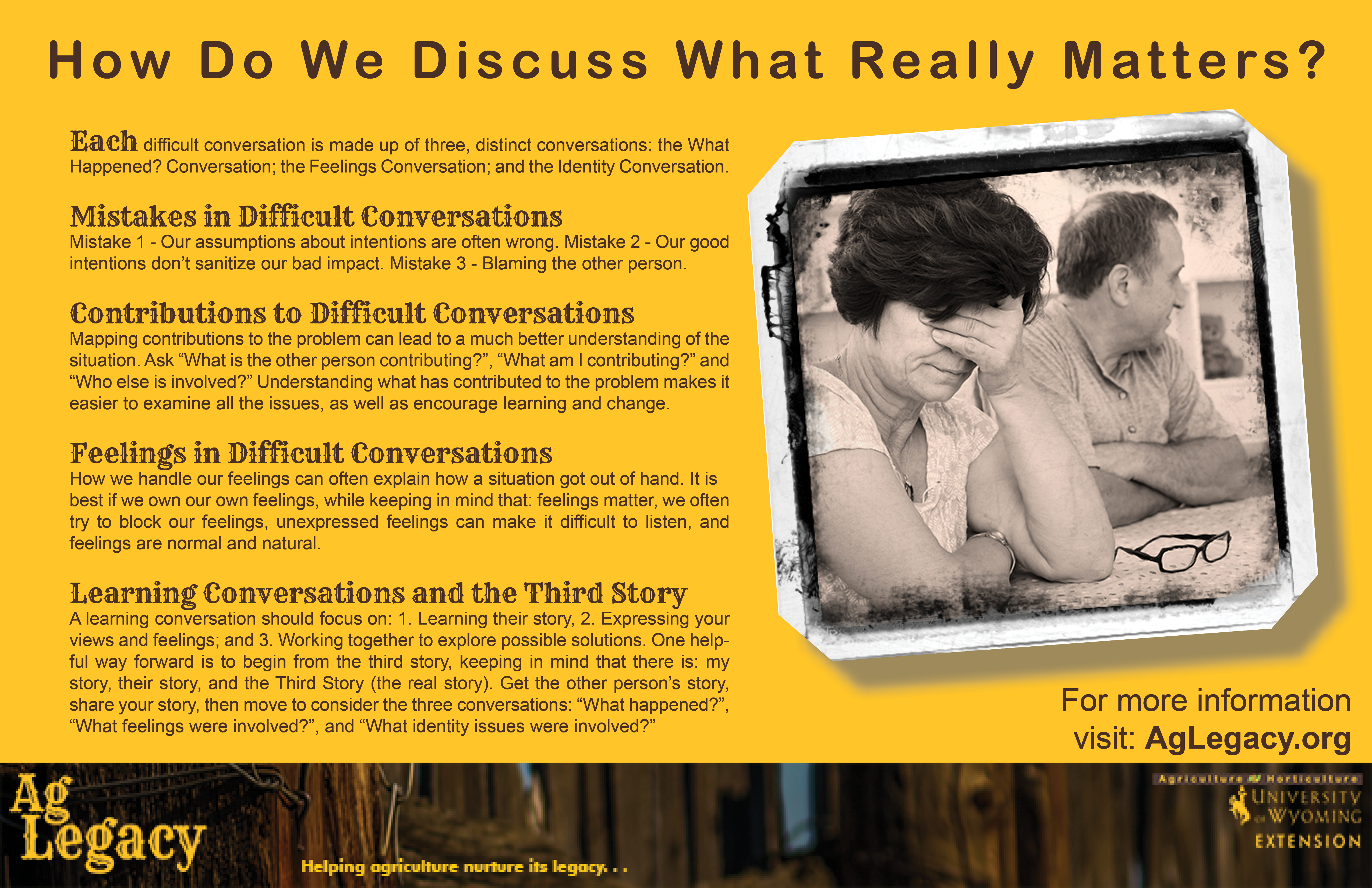
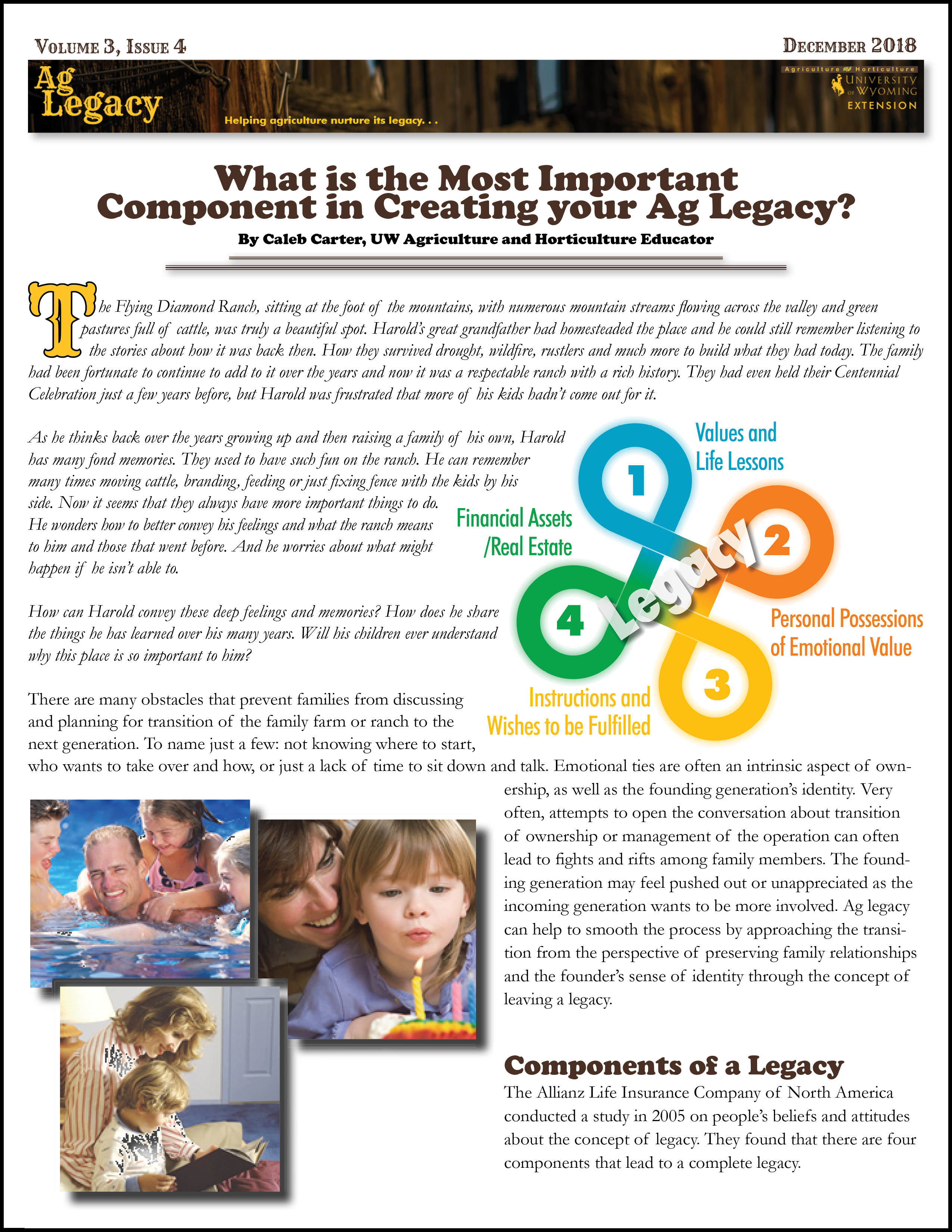
There are many obstacles that prevent families from discussing and planning for transition of the family farm or ranch to the next generation. To name just a few: not knowing where to start, who wants to take over and how, or just a lack of time to sit down and talk. Emotional ties are often an intrinsic aspect of ownership, as well as the founding generation’s identity.

…to read more click here

AG LEGACY

AgLegacy_IMAGE

##AGLEGACY.org #FarmSuccession #EstatePlanning

Helping agriculture nurture its legacy . . .
A legacy is the summation of a lifetime of achievement and the context in which that lifetime will be remembered. A legacy is not just money but a reputation, what was accomplished, and the difference a person makes in the world as they pass through.

How Do We Discuss What Really Matters?

AgLegacy_IMAGE

#AGLEGACY.org #FarmSuccession #EstatePlanning

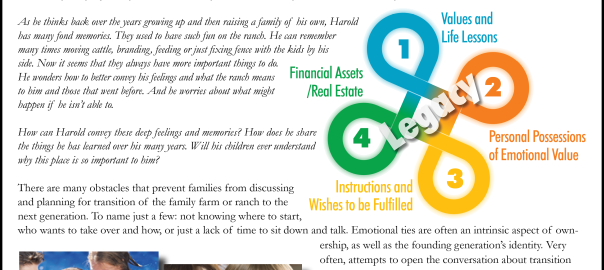
Each difficult conversation is made up of three, distinct conversations: the What Happened? Conversation; the Feelings Conversation; and the Identity Conversation.

Mistakes in Difficult Conversations
Mistake 1 – Our assumptions about intentions are often wrong. Mistake 2 – Our good intentions don’t sanitize our bad impact. Mistake 3 – Blaming the other person.

Contributions to Difficult Conversations
Mapping contributions to the problem can lead to a much better understanding of the situation. Ask “What is the other person contributing?”, “What am I contributing?” and “Who else is involved?” Understanding what has contributed to the problem makes it easier to examine all the issues, as well as encourage learning and change.

Feelings in Difficult Conversations
How we handle our feelings can often explain how a situation got out of hand. It is
best if we own our own feelings, while keeping in mind that: feelings matter, we often try to block our feelings, unexpressed feelings can make it difficult to listen, and feelings are normal and natural.

Learning Conversations and the Third Story
A learning conversation should focus on: 1. Learning their story, 2. Expressing your views and feelings; and 3. Working together to explore possible solutions. One helpful way forward is to begin from the third story, keeping in mind that there is: my story, their story, and the Third Story (the real story). Get the other person’s story, share your story, then move to consider the three conversations: “What happened?”, “What feelings were involved?”, and “What identity issues were involved?”
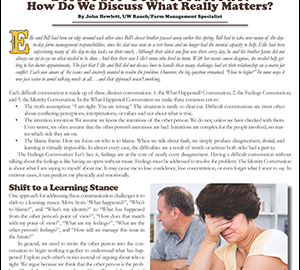
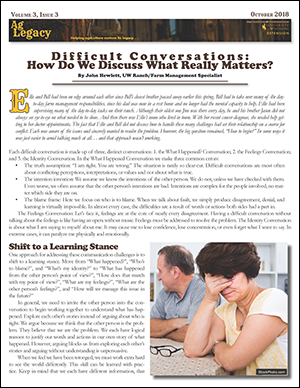
Difficult Conversations: How Do We Discuss What Really Matters?

2018_10_AgLegacyNewsletter

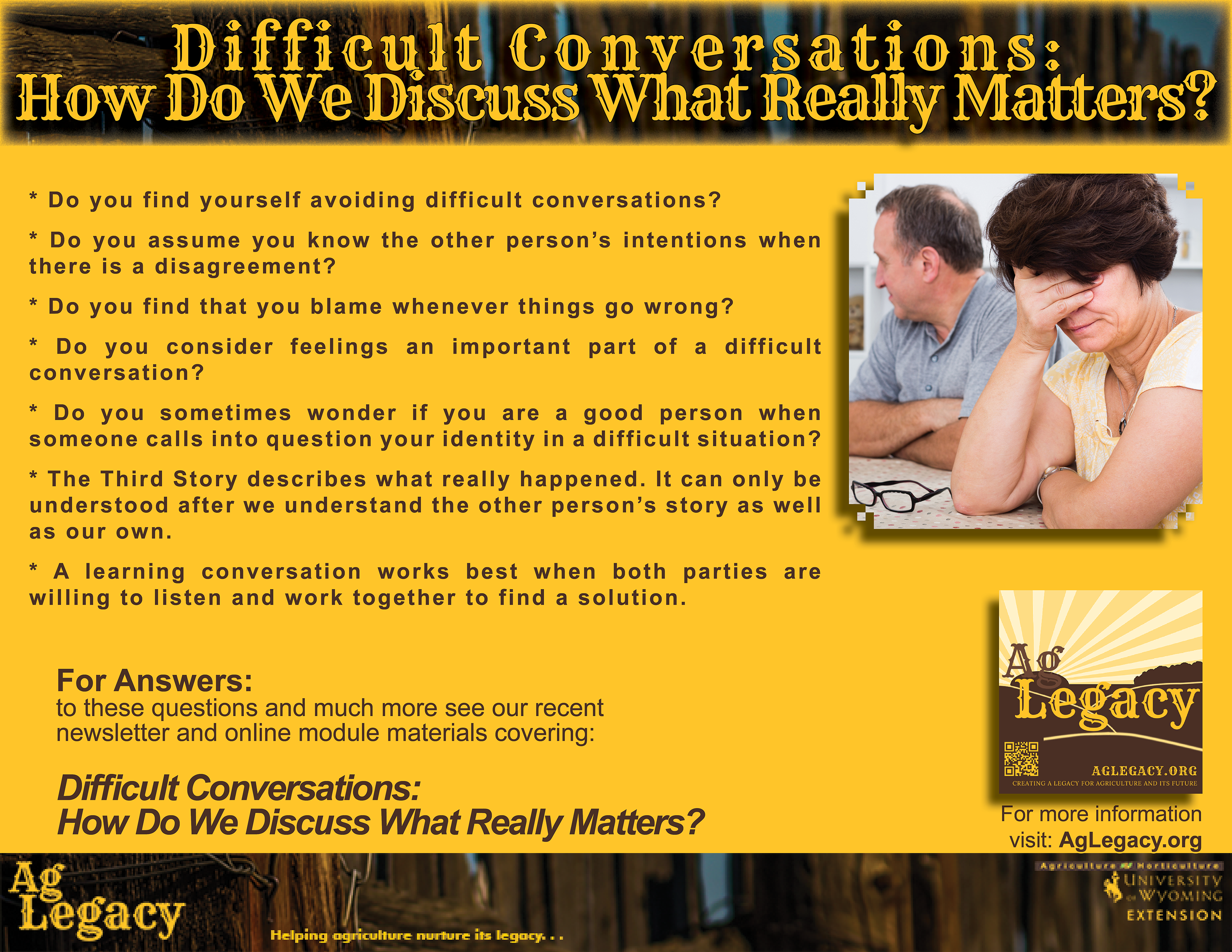
Difficult Conversations:
How Do We Discuss What Really Matters?

Each difficult conversation is made up of three, distinct conversations: 1. the What Happened? Conversation; 2. the Feelings Conversation; and 3. the Identity Conversation. In the What Happened Conversation we make three common errors: the truth assumption, the intention invention, and the blame frame. Each error must be addressed in order to move forward. The Feelings Conversation: Feelings must be addressed to resolve the problem. Having a difficult conversation without talking about the feelings is like having an opera without music. The Identity Conversation is about what I am saying to myself about me. It may cause me to lose confidence, lose concentration, or even forget what I want to say. In extreme cases, it can paralyze me physically and emotionally.

…to read more click here

Wyoming Wills: Some Suggestions for Getting the Most from Estate Planning

AgLegacy_IMAGE

#AGLEGACY.org #FarmSuccession #EstatePlanning

A will is a document that describes the last wishes of an individual after his or her death, including how property should be distributed and who should manage the estate of the deceased person. A will’s primary functions can be divided into two categories: (1) those directing the distribution of the decedent’s estate and (2) those nominating individuals to represent the decedent and his or her estate.